I would like to introduce you to the self-description dream:
“That self-descriptions make finding collections easier for everyone, by being writable by everyone in their own language.”
That is a rather off-the-cuff expression of the philosophy of the self-description microformat, but the primary goal of a self-description is definitely to make collections easier to find.
‘Language’ as used above is not restricted to major national languages – but should be considered to be broad enough to include the language used by academics to describe a collection as disparate from that used by students to describe the same collection. Different groups of users will describe the same collection with different emphasis which will speak to other users within that ‘market segment’. (Forgive the marketing speak,
but it helps greatly to see the self-description as a marketing oppourtunity. This I’m sure will be discussed in a later post.)
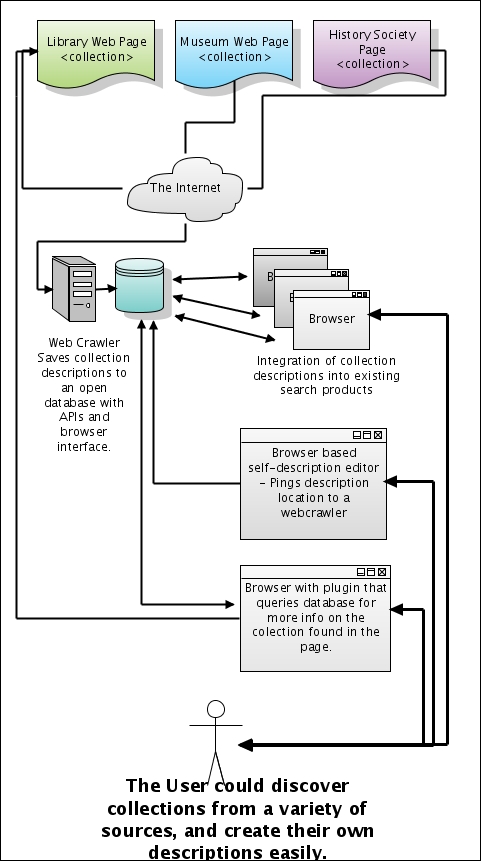
In this diagram, we see three web pages – each contains at least one collection description. The web pages are written by different organisations, and hosted in different parts if the Internet.
A web crawler is crawling some pages and finds the collection description encoded in the self-description microformat. It then extracts this data and saves it in an open repository for the collection descriptions. (There is no requirement for these two tools to be hosted by the same people.)
One key requirement of an open collection description database would be to index the data and make those indexes available through APIs.
The key thing is that the Collection Description is now freely available to all who want to use it in their projects. The collection description does not have to come from the web crawler. It may be that an existing content source that hosts its own collections – such as a journal indexing service (each journal could be considered to be a collection) – embeds in its pages the Self-description microformat. It might even supply an RSS feed of collections in a subject area that are marked up with self-description data. Another consumer could then use the data in their own applications.
A browser based editor makes it easy to select elements within an existing description and mark it up with the self-description microformat. You can see a Beta tool called Egodesc hosted here on selfdescription.org.
For the seasoned researcher or academic, a Firefox Add-on could identify the collection on a page and add it to a user’s favourite collections, along with tags in a del.icio.us style.
Those tags could even be fed back into the indexing engines to improve search.
This is a ‘stub’ if you like – and will be worked up into a ‘proper’ introduction at a point in the future.
If you like what you see here, or want to comment – please get in touch.